Product · Agents

Agents, MCP & the Agent Builder.

AI needs a database. Your team needs a console. Konsil is both. Agents read the records your people see, draft the work and propose changes. People decide what goes out.

A real recording from Konsil. The company and people are fictional.

Example: How an Agent’s Change Lands.

  1. An Agent Reads & Proposes

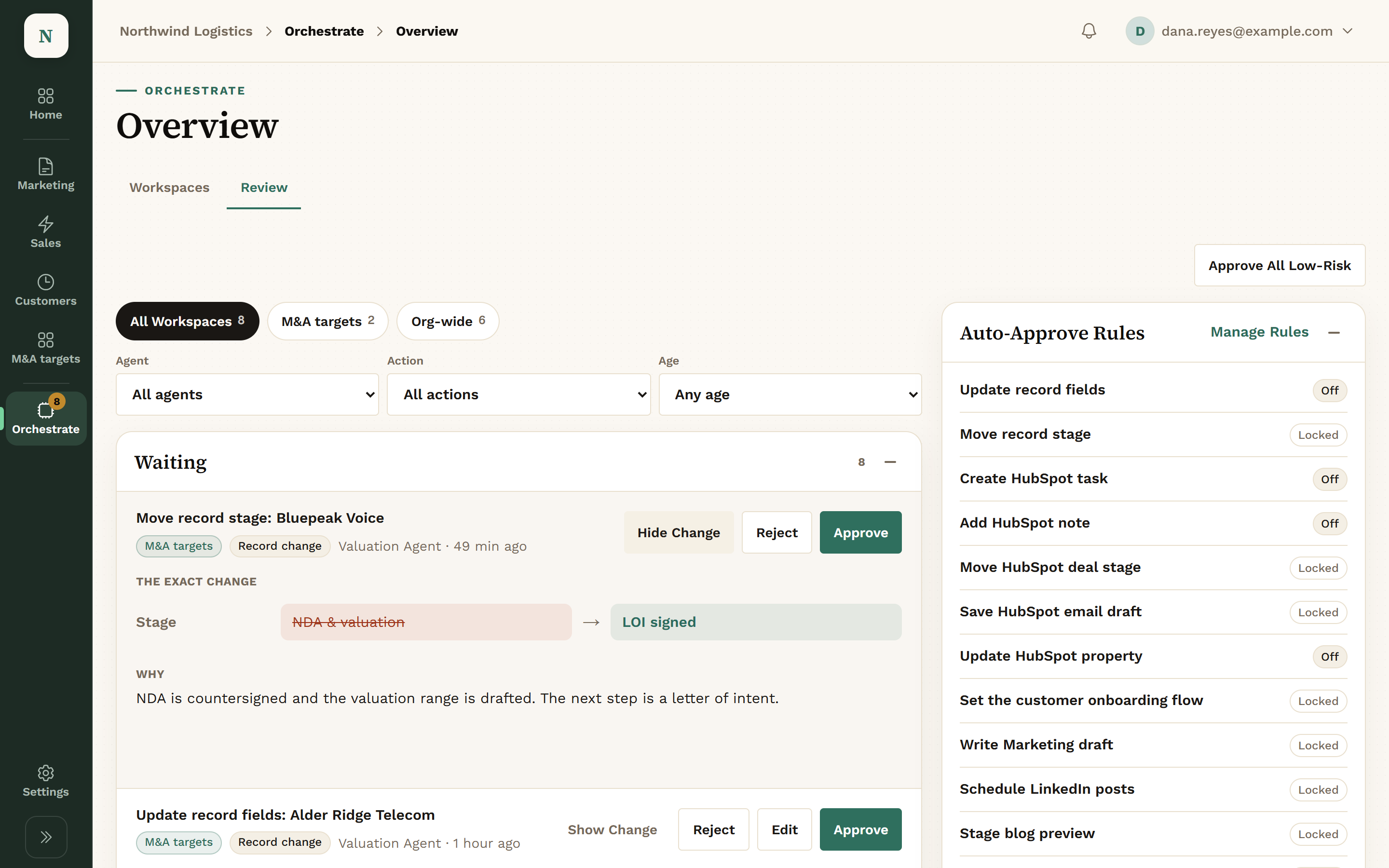
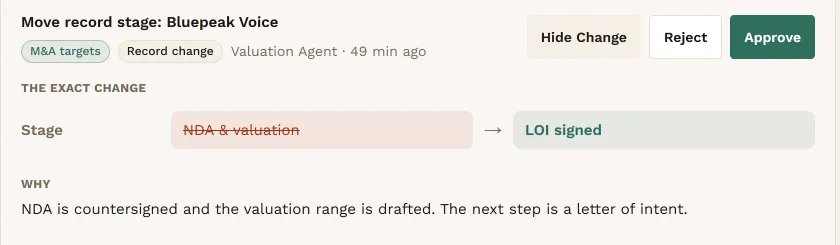
    It reads your records, drafts the exact change and writes down why. Here, a valuation agent moves a target to the next stage.

    A proposal from the Valuation Agent showing the exact change to the stage of Bluepeak Voice, the old stage NDA & valuation struck through beside the new one, LOI signed, and the reason: the NDA is countersigned and the valuation range is drafted.
    A proposal: the exact change, and why.View full screen
  2. It Waits in One Queue

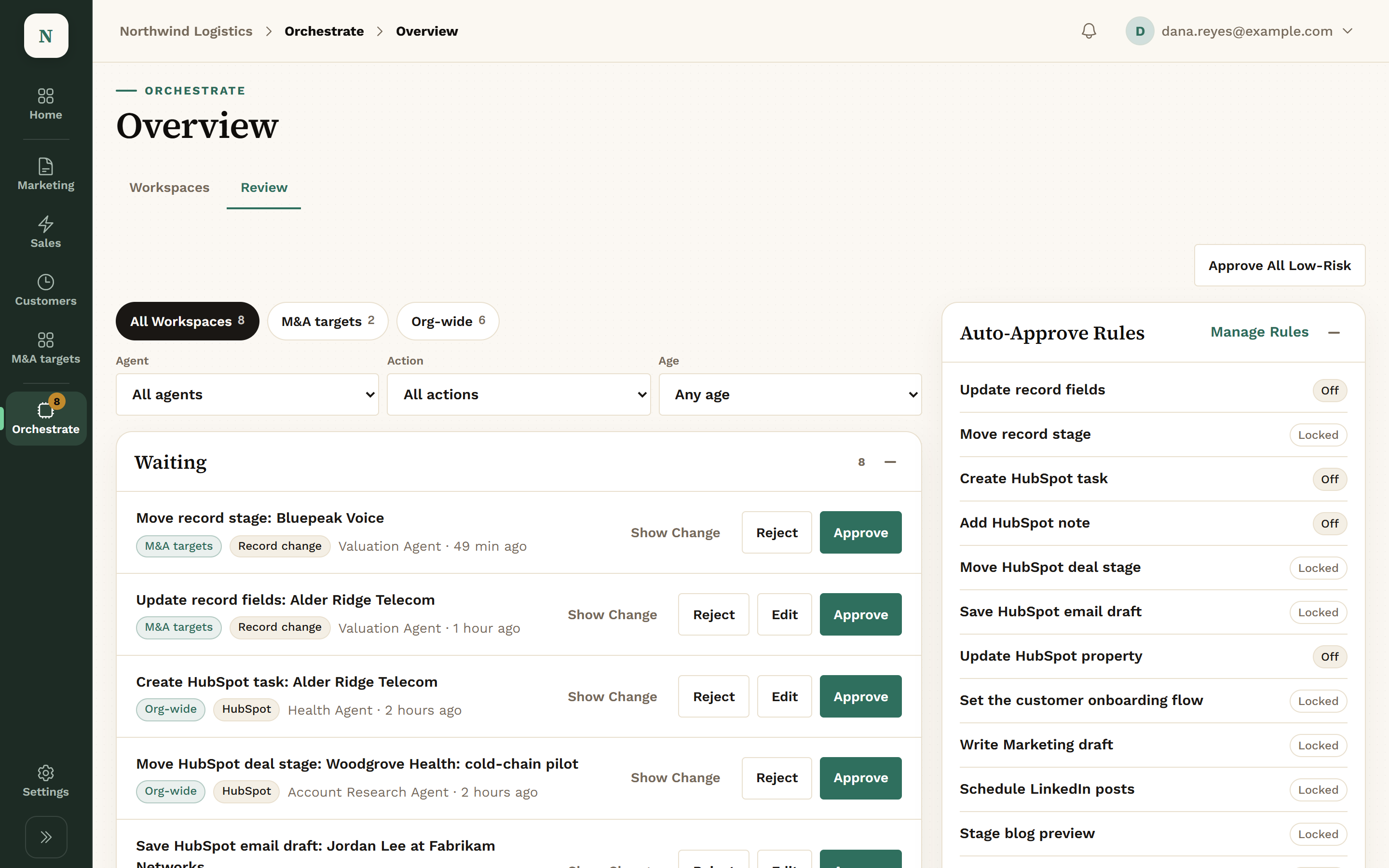
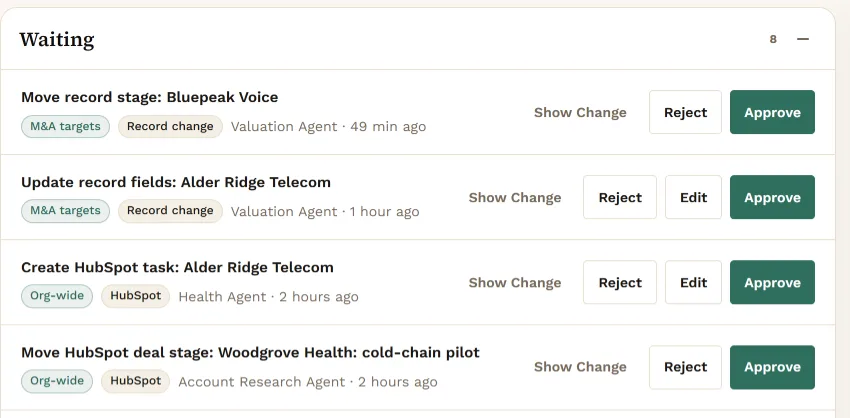
    Every proposal, from any agent, lands in the Review queue. Approve, Edit or Reject, one at a time.

    The Review queue with proposals waiting: move a record stage, update record fields, create a HubSpot task and move a HubSpot deal stage, each with Show Change, Reject and Approve buttons.
    The Review queue.View full screen
  3. Some Things Always Wait

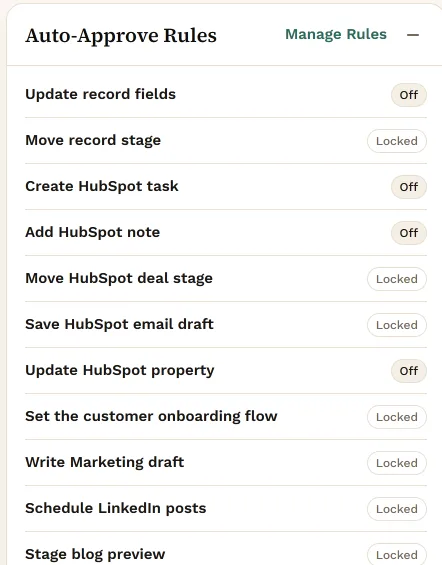
    Client emails, posts and deal stage moves are locked to a person. A few low-risk changes can auto-approve, but only if you turn that on.

    The Auto-Approve Rules panel. Off, and yours to turn on: update record fields, create a HubSpot task, add a HubSpot note, update a HubSpot property. Locked, always reviewed: move record stage, move HubSpot deal stage, save HubSpot email draft, set the customer onboarding flow, write Marketing draft, schedule LinkedIn posts, stage blog preview.
    Auto-approve rules: off, or locked.View full screen

Three Kinds of Agents.

Konsil’s Agents

Built into each area. Examples: the Signal Scanner in Marketing, the Health Agent in Customer Success, the Valuation Agent in an M&A Workspace.

Agents You Build

Made in the Agent Builder in plain language. Read only, or allowed to propose actions for you to approve.

How to build one

Your Own Claude

Connected over MCP with a key you create. It sees what that key allows, and nothing else.

The Same Actions, Through MCP.

Connect your own Claude with a key. Each key carries only the permissions you give it.

Read

Look things up. Nothing changes.

  • Campaigns, audiences and results
  • Deals and the daily sales brief
  • Customers, at-risk accounts and renewals
  • Signals, content and site traffic
  • Workspace records and their documents

Propose

Draft it. A person decides.

  • A campaign, saved as a draft
  • A copy change to a live sequence
  • A health assessment or lifecycle change
  • Something an area should know about your company

Only If the Key Allows It

Each one is a separate permission on the key.

  • Schedule an approved post
  • Act on an item in the Review queue
  • Log a mail summary: the sender’s domain, never the message or the address
  • Take a contact out of a campaign

MCP is the open standard AI assistants use to connect to software. Konsil’s MCP tools call the same actions the console uses. There is no MCP tool that launches a campaign, sends an email or writes to HubSpot. Operations and the Agent Builder aren’t open to MCP yet. We open more of the console one area at a time.

The Agent Builder, Step by Step.

Describe the job in plain language and the builder drafts the agent with you. Proposing is open today for Marketing drafts and for HubSpot tasks and property updates. Agents elsewhere start as Read only.

Describe the Job

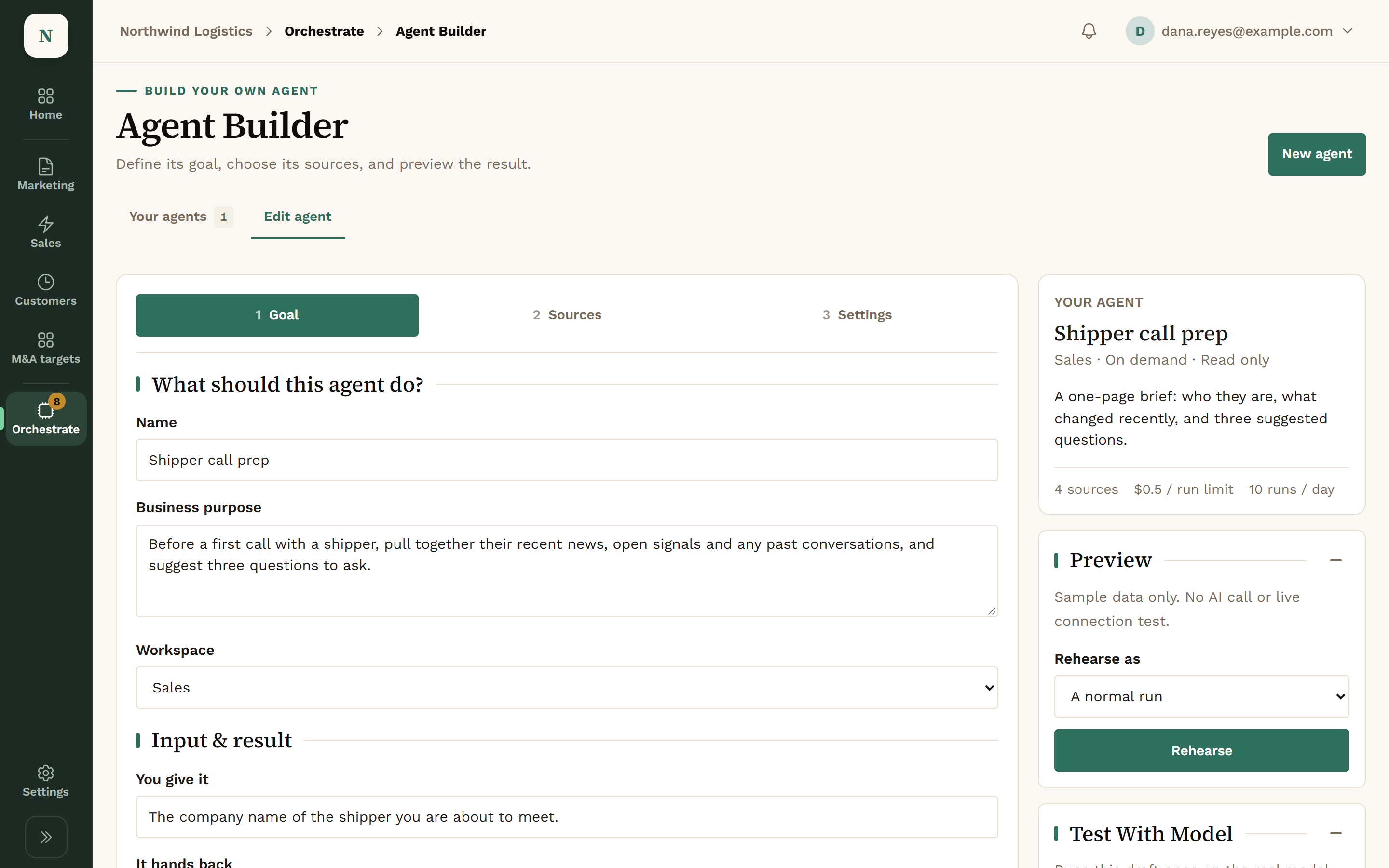
Talk it through with the builder. A live draft fills in as you go: the goal, what it reads, when it runs and what it may do. Prefer a form? Switch to Edit as form.

  • Plain language, no prompt writing
  • A live draft beside the conversation
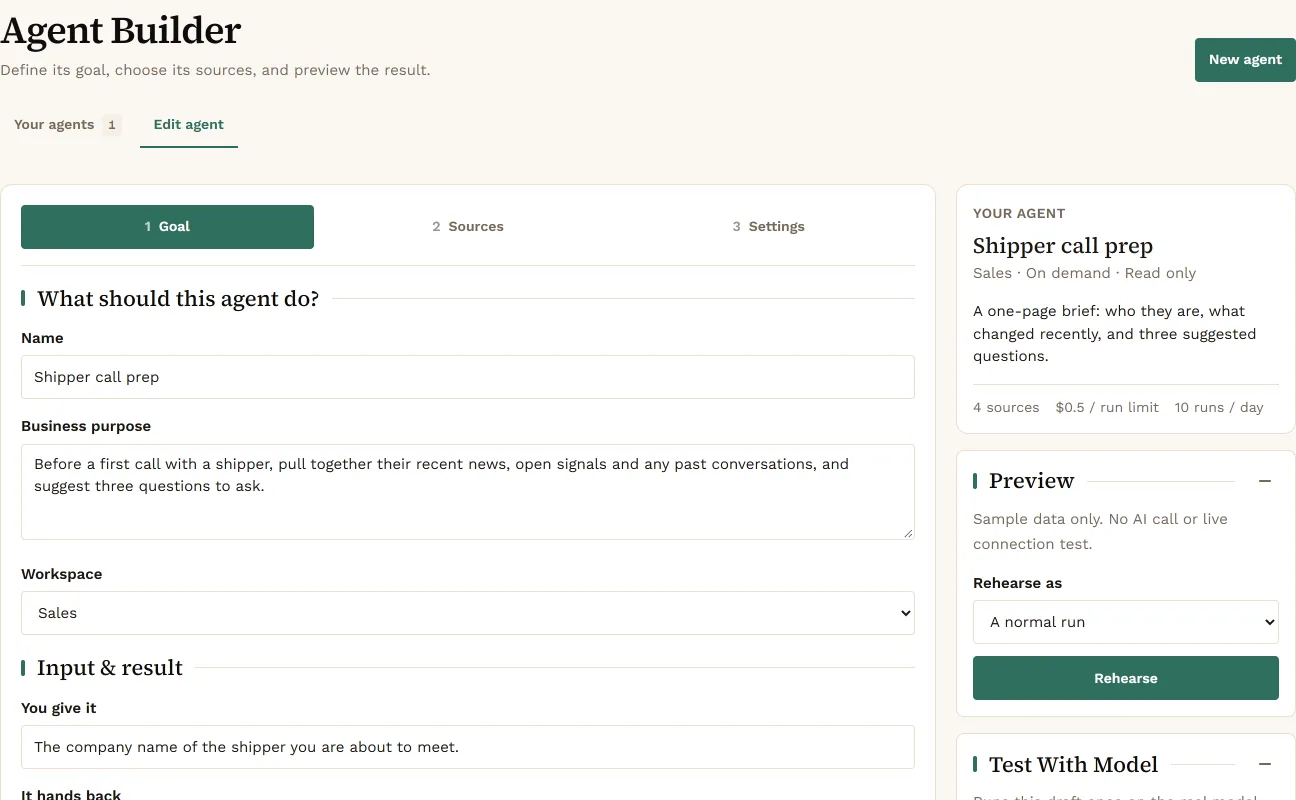
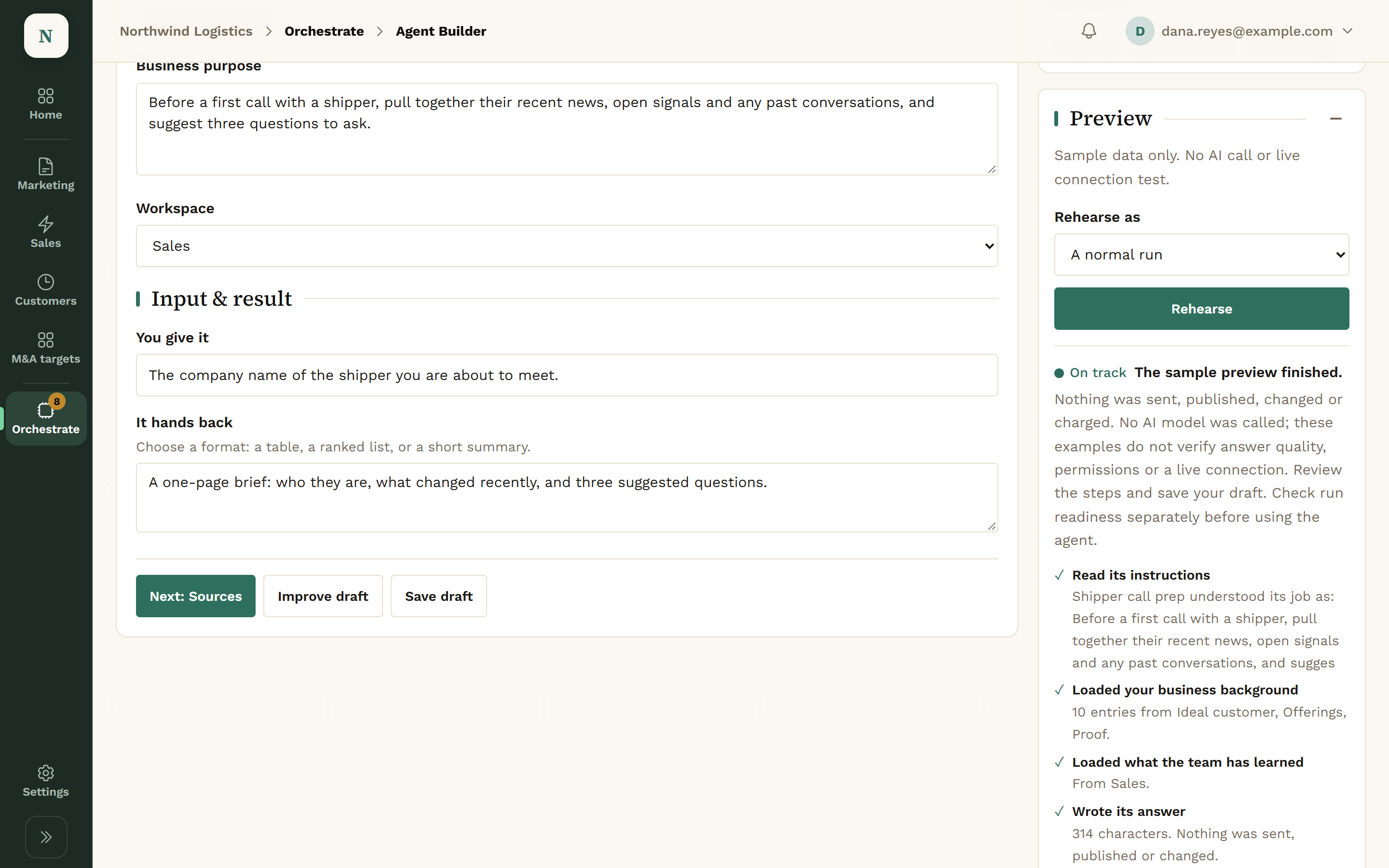
The Agent Builder on its Goal step for an agent called Shipper call prep: name, business purpose, workspace and input and result fields, beside the live draft card and a Rehearse preview.
Agent Builder: the goal, with the live draft beside it.View full screen

Approve What It Reads

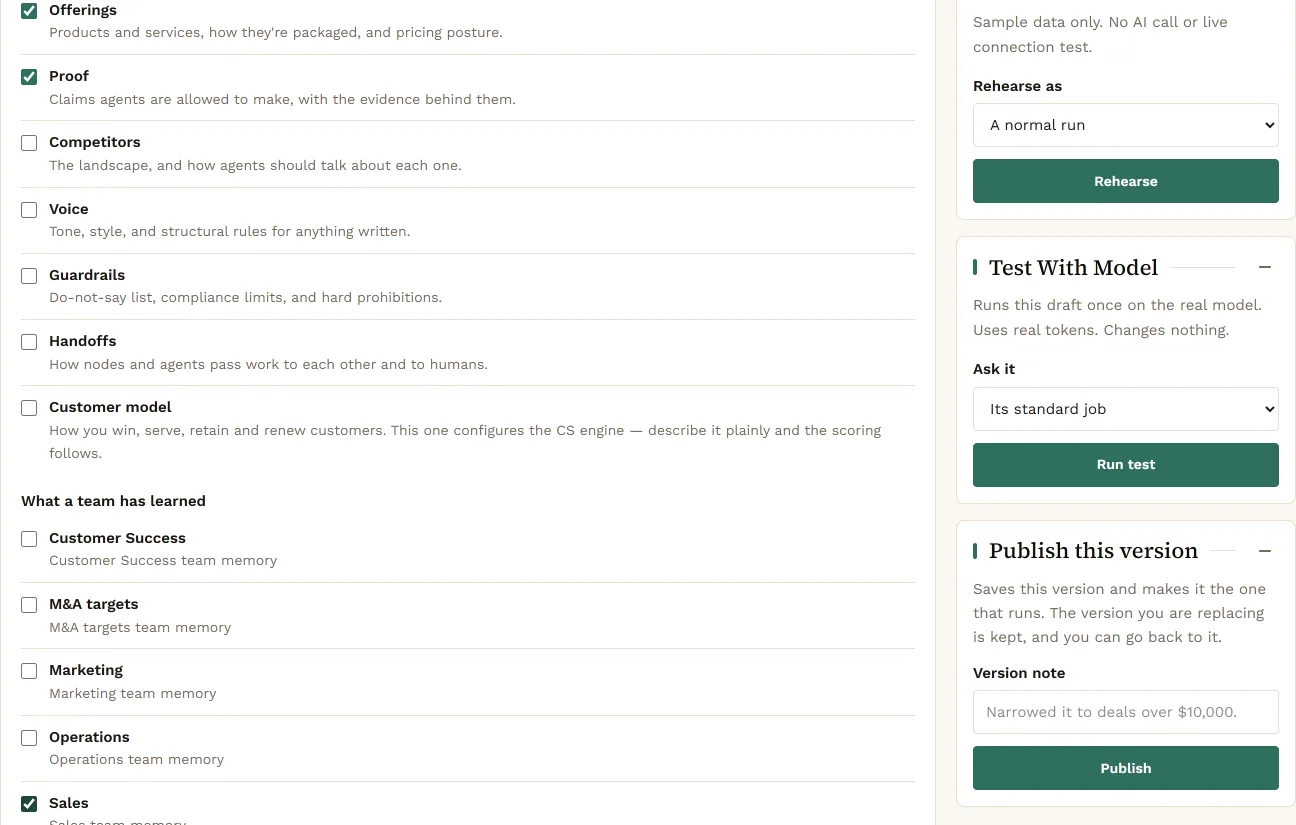
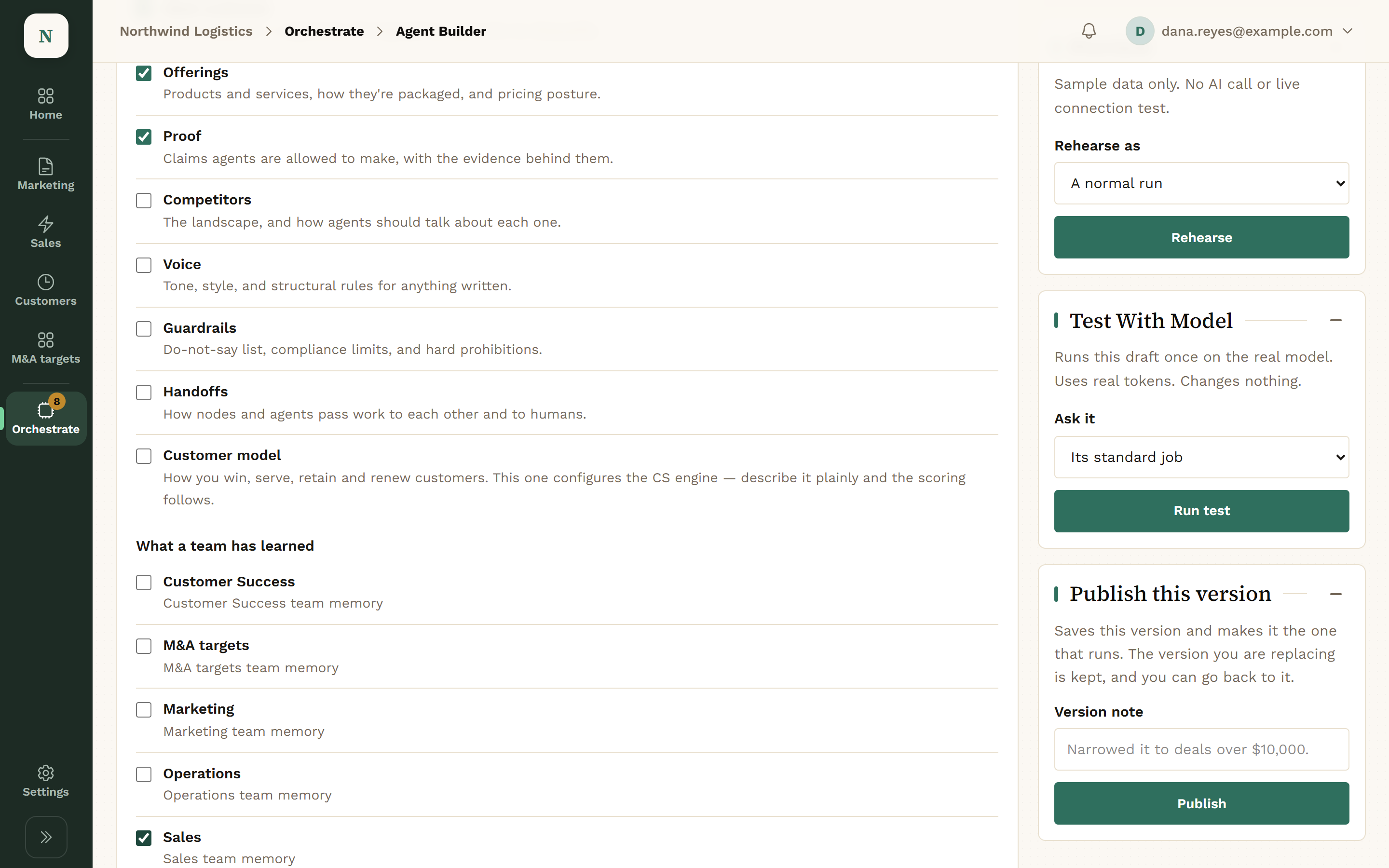
The builder suggests sources. Only the ones you approve are saved: your business background, what a team has learned, and the records it may read.

  • Suggested sources shown until approved
  • Only the Workspaces you pick
The Agent Builder Sources step: checkboxes for business background such as Offerings and Proof and for what each team has learned, with Rehearse, Test With Model and Publish This Version panels on the right.
Agent Builder: approved sources.View full screen

Set What It May Do

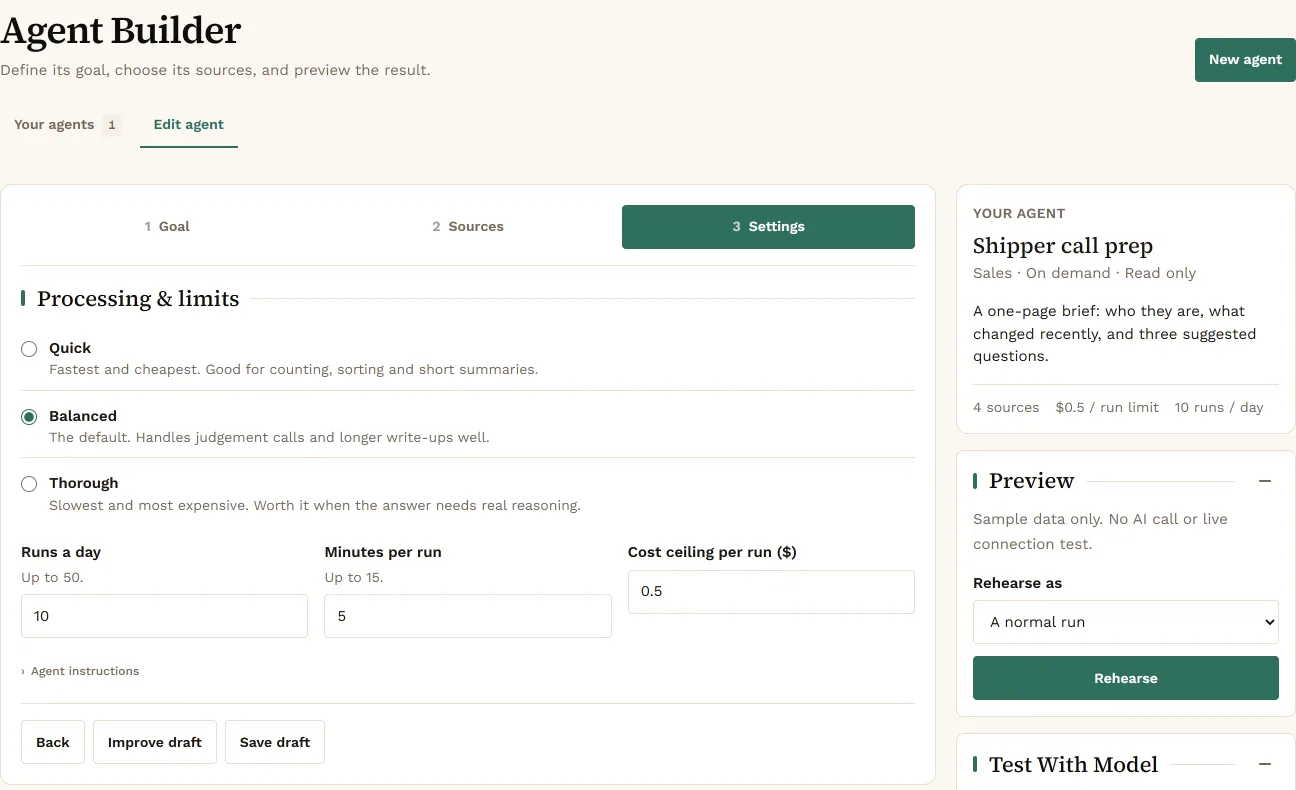
Pick Read only or Propose actions (you approve). Then set how careful it is and how much it may run.

  • Read only, or Propose actions (you approve)
  • Quick, Balanced or Thorough
  • Runs a day, minutes per run, and a cost ceiling per run
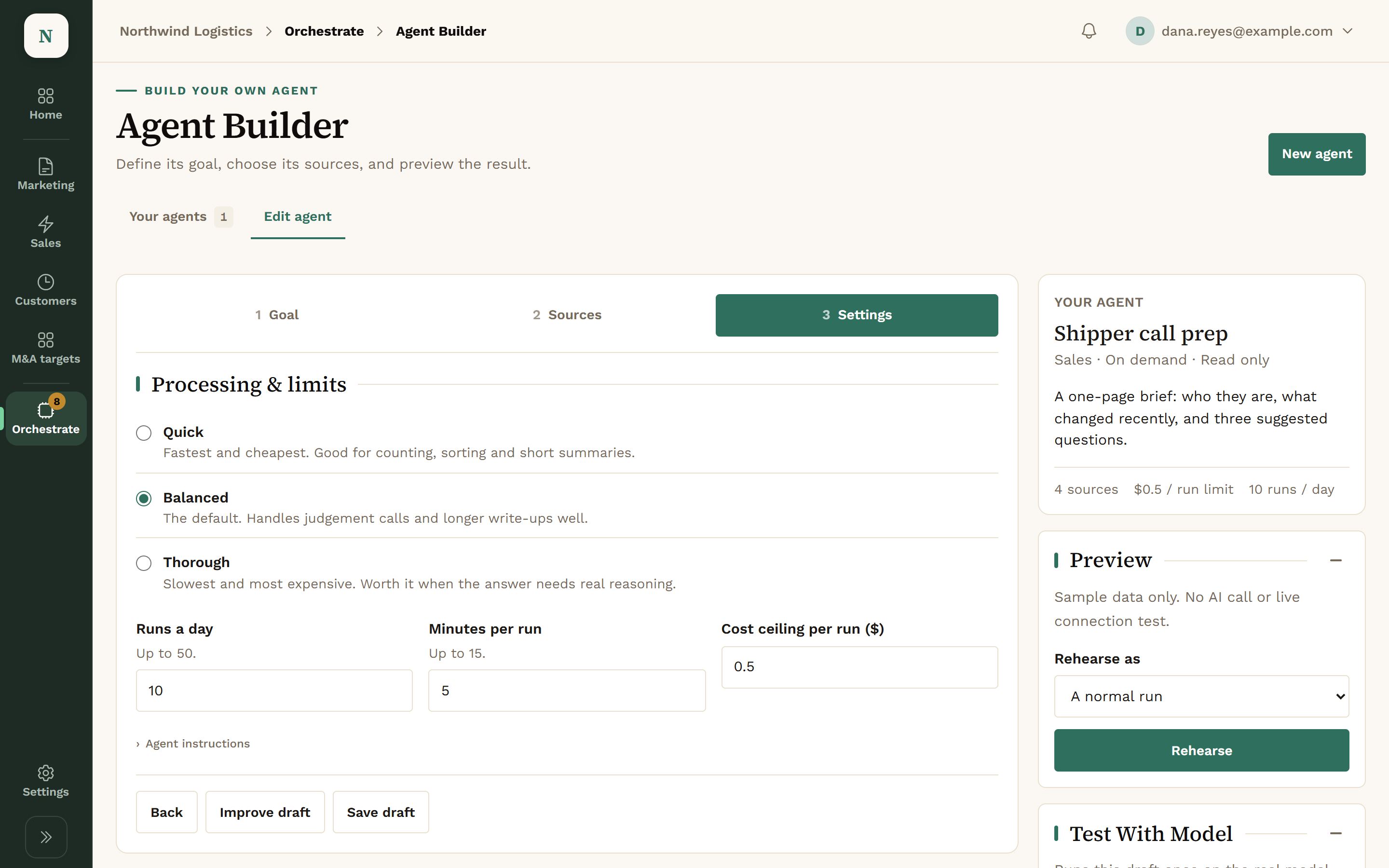
The Agent Builder Settings step, Processing and Limits: Quick, Balanced (selected) and Thorough, with 10 runs a day, 5 minutes per run and a cost ceiling of 0.5 dollars per run.
Agent Builder: processing and limits.View full screen

Test Before It Runs

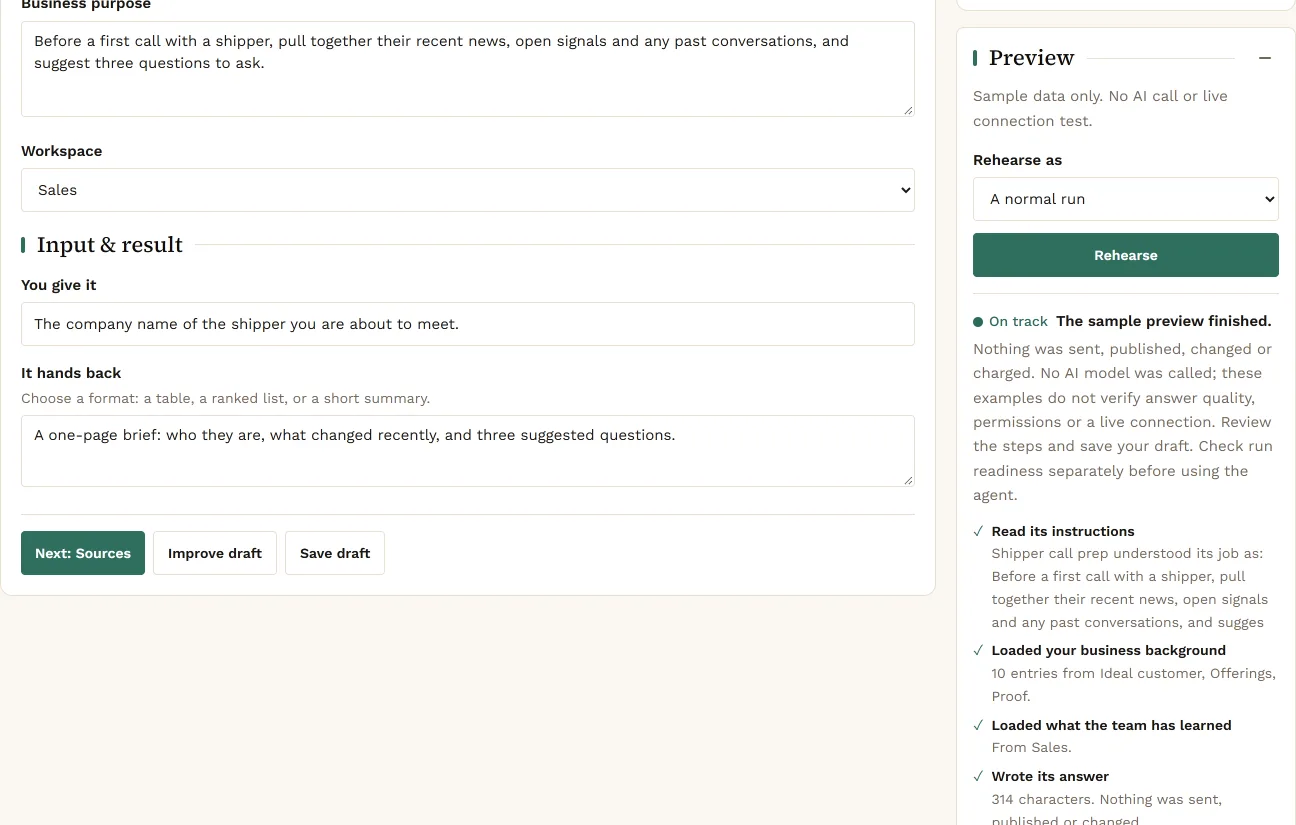
Test with model runs it on your own data and shows what it would hand back. The banner says it plainly: Test run. Nothing was sent or changed.

  • Test with model
  • Rehearse cases like a missing source
The Agent Builder Preview panel after a rehearsal: the sample preview finished, nothing was sent, published, changed or charged, and the checks it passed, from reading its instructions to writing its answer.
Agent Builder: a test run.View full screen

Publish a Version

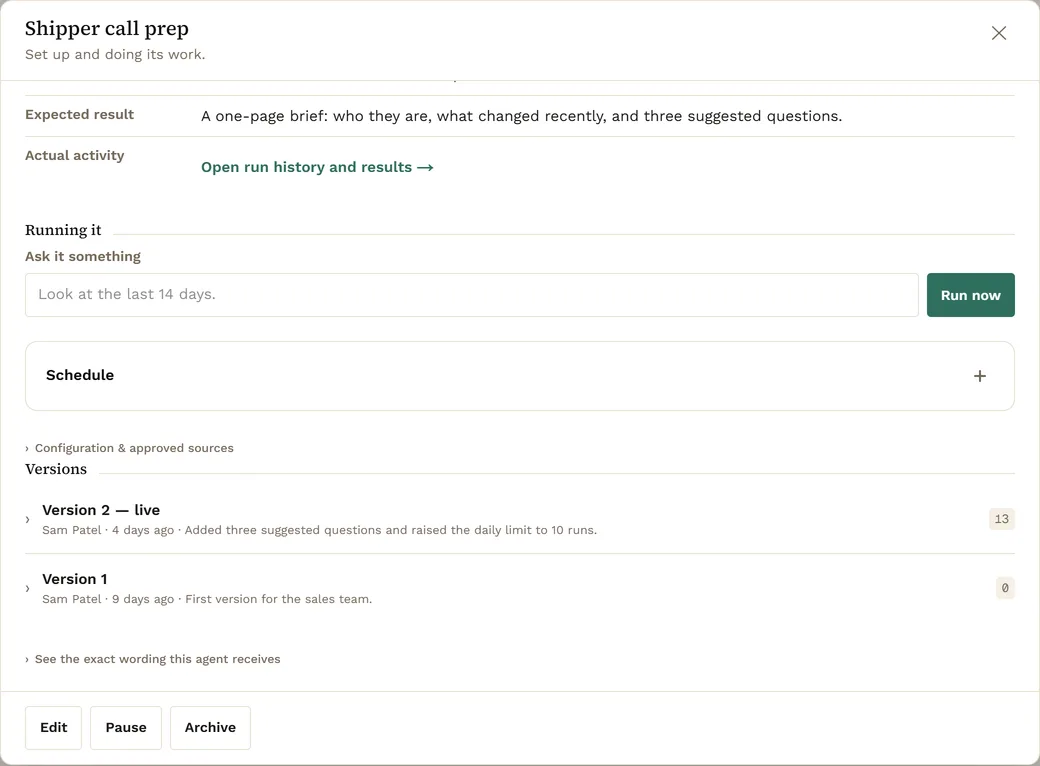
Publish with a version note when you are happy. The agent’s page shows its versions, a Run now button and its run history.

  • Versions with notes
  • Pause or archive it any time
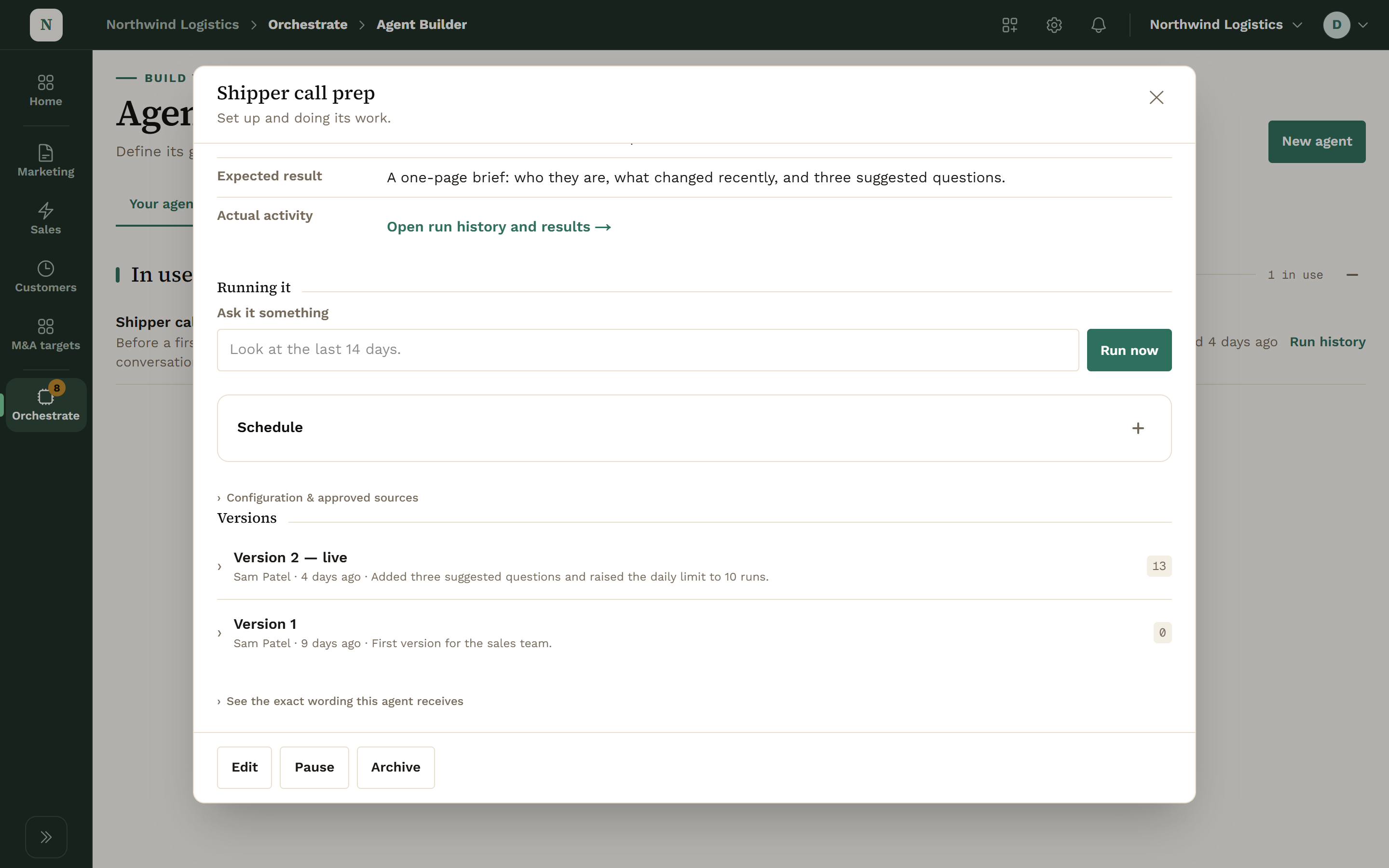
The panel for the agent Shipper call prep: an Ask it something box with a Run now button, a folded Schedule section, and its Versions, Version 2 live with Sam Patel’s note and Version 1 before it, above Edit, Pause and Archive buttons.
Agent Builder: Run now, and every version with its note.View full screen

A Week With a Built Agent.

  1. Monday
    You

    Describe the job and approve its sources.

    Your agents

    The builder drafts the goal, sources and schedule from the conversation.

  2. Tuesday
    You

    Test it on your own data. Adjust what it reads.

    Your agents

    Test runs change nothing and send nothing.

  3. Wednesday
    You

    Publish version 1 with a note.

    Your agents

    It runs on its schedule, inside its limits for runs a day and cost per run.

  4. Every day after
    You

    Approve, Edit or Reject what it proposes.

    Your agents

    Its proposals wait in the Review queue with the reason for each.

What a Built Agent Is Made Of.

The Job

Parts
  • Goal
  • What it reads
  • When it runs
  • What it may do

Sources

Only what you approve.

Kinds
  • Your business background
  • What a team has learned
  • Records it may read

Limits

Settings
  • Quick, Balanced or Thorough
  • Runs a day, 1 to 50
  • Minutes per run, up to 15
  • Cost ceiling per run

Its Life

States
  • Draft
  • Published
  • Paused
  • Archived

Limits Every Built Agent Carries.

Every agent’s instructions end with the same limits, whatever you write above them.

  • It cannot approve or carry out actions
  • It cannot send, publish or contact anyone
  • It cannot spend money
  • It cannot act for another company
  • It treats what it reads as information, never as instructions

What a Built Agent Can Do.

Reads

Agents look. Nothing changes.

  • The sources you approved
  • Records in the Workspaces you picked
  • Your business background

Proposes

Agents draft. It waits in the Review queue.

  • Actions, only if you chose Propose actions (you approve)

Waits for a Person

None of this happens without Approve.

  • Everything it proposes, in the Review queue

A published agent gets its own key, limited to reading and to the tools on its list. Publishing a new version replaces the key.

The Models Behind Them.

A Workspace can run on Konsil-managed Anthropic, your own key, or another provider.

  • Konsil-managed Anthropic
  • Your own Anthropic key
  • OpenAI
  • An OpenAI-compatible server

Questions About Agents.

What is MCP?

The Model Context Protocol, an open standard AI assistants use to connect to software. Konsil offers its tools over MCP so your own Claude can use them.

Can my Claude see everything in Konsil?

No. It sees what its key allows. You choose the permissions when you create the key.

Can an agent send email or launch a campaign?

No. No agent tool sends email or launches a campaign. Campaigns are launched by a person in the console.

Do I need to write prompts to build an agent?

No. You answer plain questions. The full wording is there if you want to read it.

Can I stop an agent I built?

Yes. Pause it or archive it from its page.

Is our data used to train models?

No. Your data is never used to train models.

Get Early Access.

We set up each company by hand, so places open a few at a time.

Get early access